The 30-minute recovery window. Not a myth.
You have probably heard it a hundred times. "You have 30 minutes after exercise to refuel." The bottle is in your hand before you have racked the bike. The protein shake is on the kitchen counter before the run. Miss the window and your recovery is ruined.
Then someone told you it was all made up. That the research was flawed, that timing does not matter, that total daily intake is all that counts. So you stopped worrying about it.
Here is the problem with that. For endurance athletes, the window is real. The people telling you to ignore it are not talking to you.
Where the confusion came from
In the late 1990s and early 2000s, a wave of research challenged the original recovery window studies. Newer work showed that in moderately active people doing light to moderate exercise, the difference between eating at 30 minutes and eating two hours later was small. Researchers started talking about a much wider window, and that message got picked up by the fitness media and turned into "timing does not matter."
But that research was not done on endurance athletes. It was done on people doing gym sessions, moderate cardio, and resistance training at relatively low volumes. The physiology is different.
What actually happens in your body after a hard session
When you finish a long ride, a threshold run, or a hard swim session, your muscles are in a state they are not in at any other point in the day. Exercise depletes glycogen and creates micro-damage in muscle fibres. In response, your body increases its capacity to absorb glucose and amino acids into muscle cells significantly faster than at rest. This effect is strongest in the first 30 to 45 minutes and starts to decline after that.
For an athlete who trained hard, who emptied a significant amount of glycogen, and who has another session coming up in 24 hours or less, that window matters. The faster you start restocking glycogen, the more recovered you are for the next session. The faster you get protein in, the sooner muscle repair begins.
This is not about being obsessive. It is about understanding that your body is doing something specific in that window, and that feeding it at the right time is not the same as feeding it two hours later.
Who the "timing does not matter" advice actually applies to
Someone going to the gym twice a week doing moderate weights. Someone doing a 30-minute jog. Someone who did not deplete much glycogen and whose next session is three days away.
For those people, yes, total daily intake matters more than a stopwatch. But that is not who M0VE is built for.
If you are training four, five, or six times a week. If you are doing sessions over 90 minutes. If you race. If you do back-to-back days. Your recovery physiology behaves differently, and the window is not something to dismiss.
What to eat in the window
For sessions over 60 minutes at moderate to high intensity, in the 45 minutes after finishing, aim for:
30 to 40g protein. Enough to kick off muscle protein synthesis. Greek yoghurt, eggs, chicken, a protein shake.
60 to 80g carbohydrate. Enough to start restocking glycogen. Rice, toast, a banana with oats, a recovery shake.
500ml fluid with sodium. Especially if you sweated heavily or trained in heat.
This does not need to be a perfectly engineered recovery meal. It needs to happen, and it needs to happen reasonably soon.
The part that is true about timing not mattering
There is a version of the "timing does not matter" argument that is correct, and it is worth knowing. If your overall daily protein and carb intake is consistently too low, eating within 45 minutes fixes nothing. Chronically under-fuelled athletes do not recover well regardless of when they eat after a session. Total daily intake is the foundation. Recovery timing is what you build on top of it when the foundation is solid.
So it is not timing versus totals. It is totals first, timing when it counts.
Where M0VE comes in
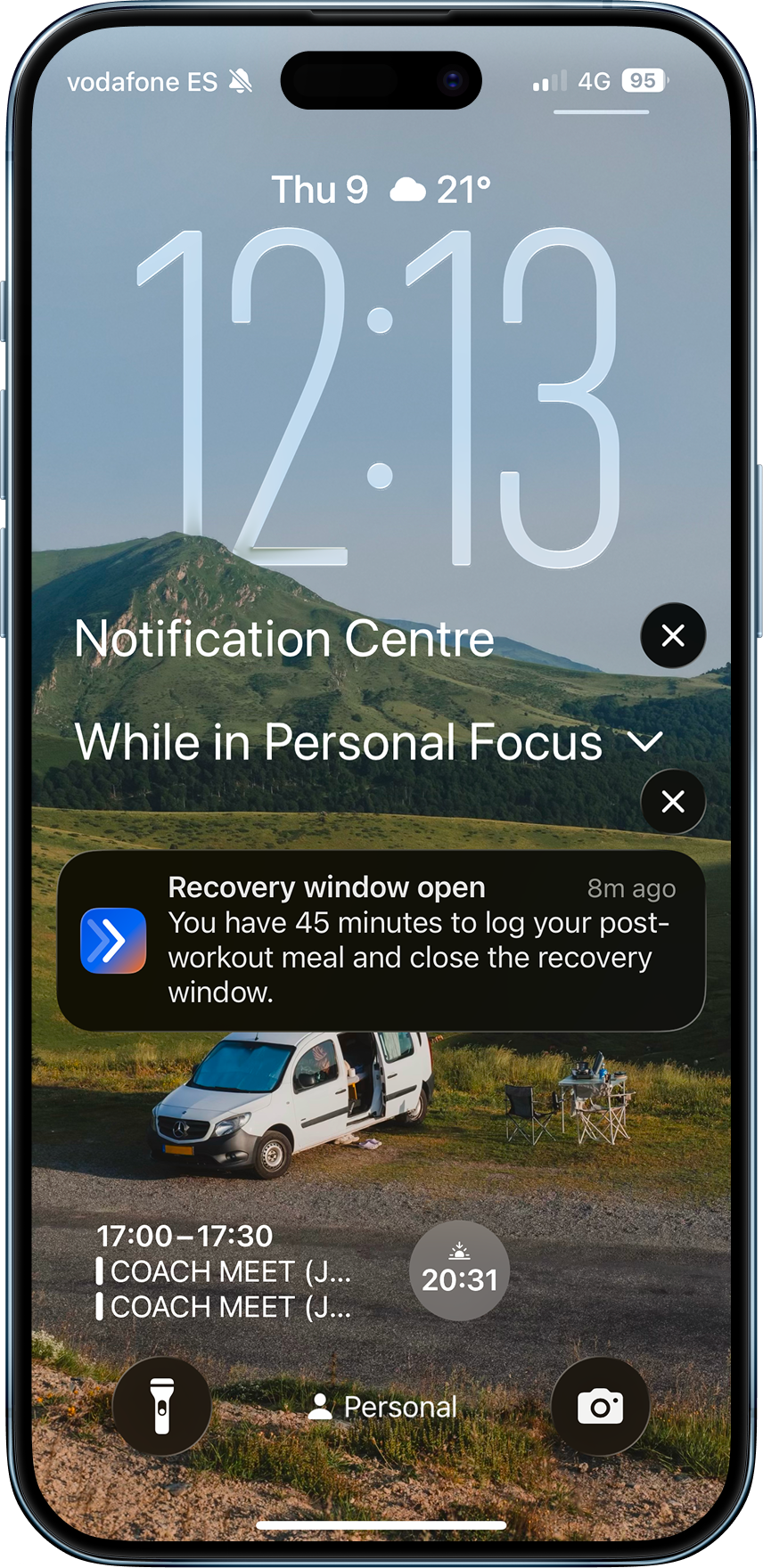
M0VE notifies you the moment your recovery window opens after a session. Your post-session targets for carbs and protein are calculated based on what you actually trained, not a generic number. On a big day, your targets go up. On an easy day, they come down.
No guesswork. No missed windows.
Try M0VE free for 14 days. Connect Strava or Intervals.icu and see it in action.
Put this into practice
MOVE applies these principles automatically, personalised to your sport, weight and training load.
Download M0VE